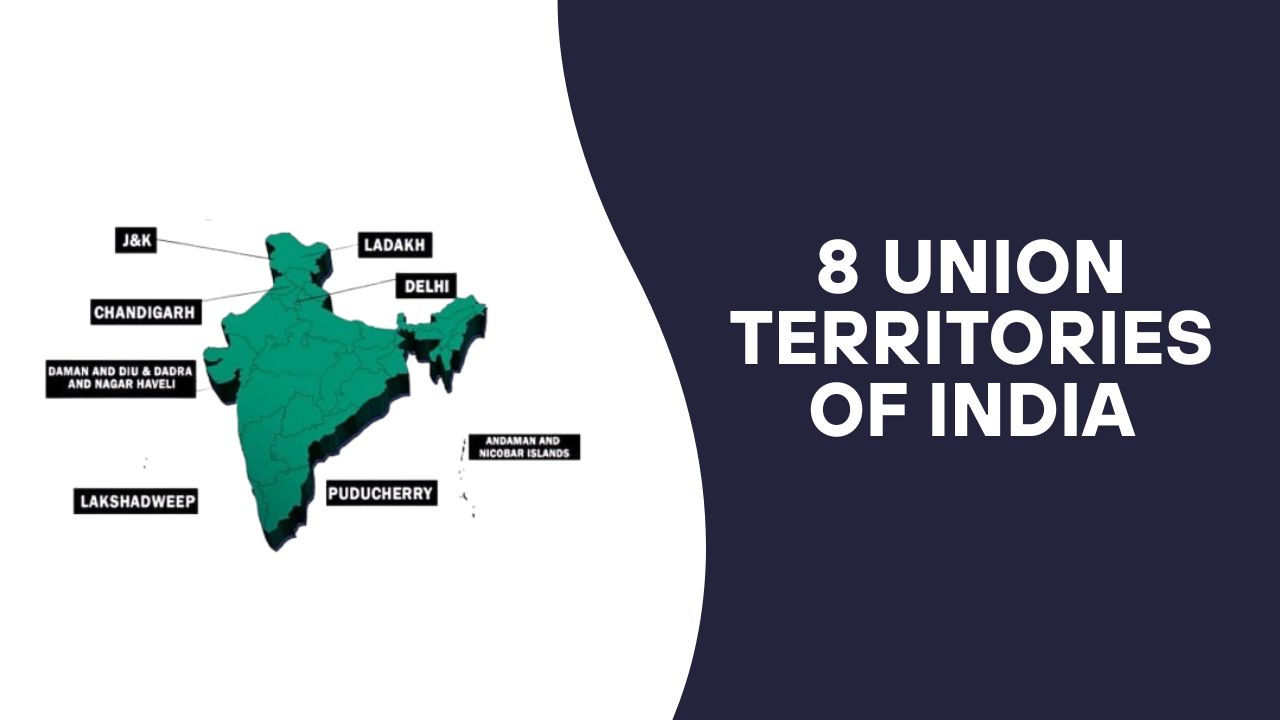
Can you believe that there is a mini-island group in Bay of Bengal and a hyper-metro like Delhi? Sounds strange, right? Which is the magic of Indian administration – and confusion! I was very honest about starting to research about the 8 Union territories of India – I assumed it was “smaller states. As it were, I had it all wrong.
As far as I can see, most of people get states and U.Ts mixed up all the time especially when studying for competitive exams and when travelling to another state or union territory. Hence, I made it a point to research, gather the facts from authentic government resources, and collate all that you need to know about the 8 Union Territories of India in a no-nonsense manner.
You will be able to learn the list of 8 union territories of India complete with their capital, special features and importance to India’s political establishment at the end of this article. Let’s get into it.
What Makes a Union Territory Different From a State?
But before you get to the list, let’s first get the groundwork. In India there is at least one state with an elected government which has a certain degree of autonomous authority. A union territory, however, is directly governed by the Central Government, typically through some kind of Administrator or Lieutenant Governor, appointed by the President of India.
This does not imply that all the U.T. states are exactly alike. Delhi and Puducherry, for instance, have legislative assemblies which have statehood-like powers. The other territories such as Lakshadweep and Chandigarh have complete administration under the central government.
This distinction is always lost on well-informed people, even throughout their eyes and mind, so pay attention to it as we proceed.
The Complete List: 8 Union Territories of India and Their Capitals
The official government websites and Geography resources material have been thoroughly checked and here is the right and updated list of the 8 Union Territories of India and their Capitals.
| Union Territory | Capital | Formed In |
| Jammu and Kashmir | Srinagar (Summer) / Jammu (Winter) | 2019 |
| Ladakh | Leh | 2019 |
| Delhi (NCT) | New Delhi | 1956 |
| Chandigarh | Chandigarh | 1966 |
| Puducherry | Puducherry | 1963 |
| Andaman and Nicobar Islands | Port Blair | 1956 |
| Lakshadweep | Kavaratti | 1956 |
| Dadra and Nagar Haveli and Daman and Diu | Daman | 2020 |
This table alone answers one of the most searched questions online: What are the 8 union territories of India. But there’s a lot more to explore beyond just names and capitals.
A Closer Look at Each Union Territory
1. Jammu and Kashmir: The Land of Valleys and Villages
The Union Territory was formed after August 5, 2019 in accordance with the scrapping of Article 370. After sending my soul on a couple of journeys into various travel blogs and Government sources, I realized that something had changed here from merely being a “pure” union territory, and it was the establishment of the Legislative Assembly of Jammu and Kashmir.
Dual Capital System (Srinagar in summer and Jammu in Winter) is unique and shows diversities in climate and geography of the region.
2. Ladakh: India’s Cold Desert Paradise
In 2019, the area of Ladakh was separated from the state of Jammu and Kashmir. The Centre administers Ladakh directly instead of a legislative assembly as it does for its neighbour. Therefore the decisions here are quicker but the representation local is limited.
People who like to enjoy the mountains, monasteries and who want to look into the sky must not miss Ladakh from their travel lists.
3. Delhi: More Than Just the National Capital
Officially, Delhi is known as National Capital Territory, which is the most popularly known U.T out of the total 8 U.T of India. It also has its own elected government and Chief Minister with some subject areas, such as law and order, remaining subject to central control.
I have seen it in practice; this hybrid governance system can cause tensions between the state government and the Central government, which you’ve seen in the news recently.
4. Chandigarh: The Shared Capital City
In my research I came across this interesting fact: Chandigarh is the capital of not only Haryana but also Punjab; however itself is a union territory. Planned by renowned architect Le Corbusier, the city features a neat plan, greenery, and modern design.
5. Puducherry: A Slice of French Heritage
Previously this coastal union territory was called Pondicherry and had remained a strong influence from the French colonization in its architectural, culinary and cultural aspects. Like Delhi and Union Territory of J&K, Puducherry too has its Legislative Assembly.
A number of heritage tourism sources were consulted to confirm this as a true fact and I certainly found this French Quarter to be a real other country.
6. Andaman and Nicobar Islands: India’s Tropical Treasure
This union territory lies in the Bay of Bengal and is comprised of more than 500 islands with only a small portion being populated. It is the seat of its capital, Port Blair, and is of tremendous strategic significance for Indian Navy defence.
Furthermore, it is home to an abundance of coral reefs and marine life, which makes it a popular destination for scuba diving and snorkeling.Additionally, its numerous reefs and marine biodiversity have made it a very popular spot for eco-tourism.
7. Lakshadweep: India’s Smallest Union Territory
Lakshadweep is the smallest union territory (paper-print of an Indian state) in terms of geographical size. It consists of coral islands in the Arabian Sea and just a few of these islands open for the tourists because of the environmental protection policies.
Conversely, this limitation also has maintained its pristine state of nature from other coastal areas.
8. Dadra and Nagar Haveli and Daman and Diu: The Merged Territory
The government of India combined the two union territories of Dadar and Nagar Haveli into a single union territory and Daman and Diu on 1 October 2020. The merger was designed to streamline and enhance governance efficiency and minimize duplication of administration.
The area remains popular as a tourist destination for its beaches and Portuguese architecture and Daman now is the joint capital.
Quick Comparison: Which Union Territories Have Legislative Assemblies?
| Union Territory | Has Legislative Assembly? |
| Delhi | Yes |
| Puducherry | Yes |
| Jammu and Kashmir | Yes |
| Ladakh | No |
| Chandigarh | No |
| Andaman and Nicobar Islands | No |
| Lakshadweep | No |
| Dadra and Nagar Haveli and Daman and Diu | No |
This comparison table makes it much easier to understand governance patterns across the 8 union territories of India.
Why Should You Even Care About Union Territories?
Come to think of it, I get it blanketed asked by many people. Why it matters:
- This is a frequently tested topic in various competitive exams such as UPSC, SSC, and State PSUs.
- Knowing about the system of governments can make political news easier to comprehend.
- When traveling, it is important to understand which states are considered Union territories, because certain regions, such as Lakshadweep, might require permits or other documentation.
- It helps to get a bigger picture of the India federal point of view at any given moment.
Thus, as a student, traveller or curious mind, this knowledge is of benefit.
Common Mistakes People Make While Studying This Topic
While researching I came across a number of common mistakes in students and even in readers:
- Mixing up the UT with States particularly Delhi and Puducherry.
- To distract yourself from the fact that till 2019, Ladakh and Jammu & Kashmir were a single region.
- Only three UTs have their own government, assuming all of them were turning into.
- Conversely, mixing up capitals in case of merged states such as Dadra and Nagar Haveli and Daman and Diu.
- Learn to avoid these mistakes to spare yourself considerable confusion, especially in exam preparation.
Frequently Asked Questions
Q1. What are the 8 union territories of India?
There are eight Union territories: Jammu and Kashmir, Ladakh, Delhi, the Chandigarh, the Puducherry, the Andaman and Nicobar Islands, the Lakshadweep, the Dadra and Nagar Haveli and Daman and Diu.
Q2. Which union territory has the largest area?
In terms of area, Jammu & Kashmir is the largest UT of India.
Q3. Which union territory has its own Chief Minister?
How many are the union territories in the Union of India with an own Chief Minister? Of the remaining six states, 3 states, namely Delhi, Puducherry and Jammu and Kashmir, have legislative assembly and their respective Chief Ministers who are elected allaying the fears of these three states.However, three states, Delhi, Puducherry and Jammu and Kashmir, have legislative assemblies and elected Chief Ministers, removing the fears of these three states.
Q4. Why did Jammu and Kashmir become a union territory?
In 2019 it ceased to be a special area after the State of Union Territory came into effect after the repealing of Article 370 from the Indian Union Constitution.
Q5. What is the smallest union territory in India?
Which neighbouring country of India is the largest? Lakshadweep is the least populated union territory of India by the area.
Conclusion
It is not enough to remember the names and capitals of the 8 Union Territories of India or just regurgitate them for an exam. It is not good enough to remember the names and the capitals of the 8 Union Territories of India just for the exam or just to repeat them if you are repeating them. This is dealing with the complexity of the governance of India, its multiple layers, and differences. The historical, cultural, and administrative distinctiveness of each territory—from snowy mountains of Ladakh to coral islands of Lakshadweep.
I have investigated this issue thoroughly and cross referenced several sources and can confidently say that this is a subject worthy of more focused discussion. So, next time when someone asks you what are the 8 union territories of India, apart from saying the names you will really know the story behind them.
Know More: Technical Government Job in 2026